President Donald Trump has announced that the U.S. military is considering 'very strong options' in response to escalating protests in Iran that have reportedly resulted in the deaths of hundreds of protesters. The Human Rights Activist News Agency (HRANA) confirmed nearly 500 fatalities among protesters and 48 security personnel, with indications that the actual toll could be higher.
Trump stated that Iranian officials approached him for negotiations, though he warned that action might need to be taken prior to any scheduled meetings. Iranian leaders criticized the protests, labeling demonstrators as 'vandals', while calling for pro-government rallies.
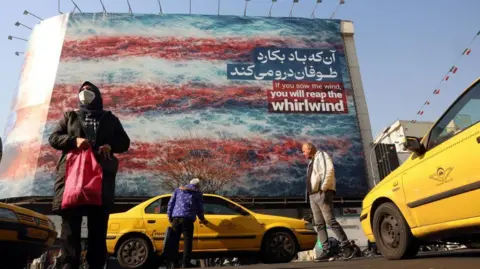
The Iranian government declared a three-day mourning period for those they term 'martyrs' in what they describe as a struggle against the U.S. and Israel, whom Tehran accuses of inciting unrest. Protests erupted over major economic issues, particularly the significant devaluation of Iran's currency, challenging the legitimacy of Supreme Leader Ayatollah Ali Khamenei.
While Trump has not detailed U.S. military strategies, discussions reportedly include military strikes against Iran and other actions such as enhancing online support for anti-government groups or imposing further sanctions.
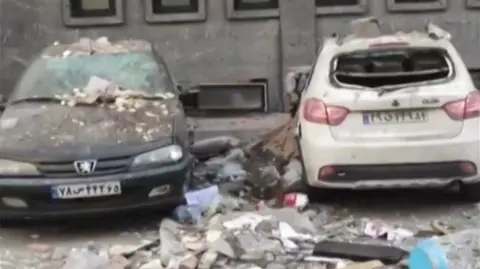
Throughout the unrest, at least 10,600 detentions have been reported. Footage from Tehran revealed a devastating scene with numerous bodies and high levels of violence. Reports of drones surveilling protests have added to the oppressive atmosphere, as an internet blackout continues to limit communication within Iran.
Trump indicated plans to speak with Elon Musk regarding potential solutions to restore internet access in Iran, demonstrating growing U.S. involvement in the crisis. The current protests are marked as the most significant since prior uprisings in 2022, highlighting deepening discontent within Iranian society.
Trump stated that Iranian officials approached him for negotiations, though he warned that action might need to be taken prior to any scheduled meetings. Iranian leaders criticized the protests, labeling demonstrators as 'vandals', while calling for pro-government rallies.
The Iranian government declared a three-day mourning period for those they term 'martyrs' in what they describe as a struggle against the U.S. and Israel, whom Tehran accuses of inciting unrest. Protests erupted over major economic issues, particularly the significant devaluation of Iran's currency, challenging the legitimacy of Supreme Leader Ayatollah Ali Khamenei.
While Trump has not detailed U.S. military strategies, discussions reportedly include military strikes against Iran and other actions such as enhancing online support for anti-government groups or imposing further sanctions.
Throughout the unrest, at least 10,600 detentions have been reported. Footage from Tehran revealed a devastating scene with numerous bodies and high levels of violence. Reports of drones surveilling protests have added to the oppressive atmosphere, as an internet blackout continues to limit communication within Iran.
Trump indicated plans to speak with Elon Musk regarding potential solutions to restore internet access in Iran, demonstrating growing U.S. involvement in the crisis. The current protests are marked as the most significant since prior uprisings in 2022, highlighting deepening discontent within Iranian society.