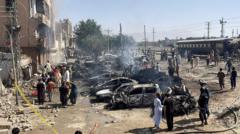
Pakistan's military says it has killed at least 92 militants blamed for deadly coordinated attacks in the south-western Balochistan province on Saturday.
The military reported that 15 security service personnel and 18 civilians were also killed during the violence. The armed forces accused India of supporting the militants, a claim that Delhi has consistently denied.
The Balochistan Liberation Army (BLA) had previously claimed responsibility for the attacks, asserting that dozens of soldiers met their end during the assaults.
Both sides' claims remain unverified as the situation unfolds in one of the province's deadliest episodes of violence, caused by decades of ethnic insurgency against the Pakistani government.
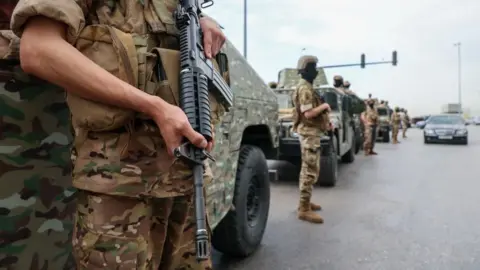
In a statement late on Saturday, Pakistan's military blamed the militants for multiple attacks targeting civilians around Quetta and other cities and asserted that it had launched 'clearance' operations across Balochistan, successfully thwarting their actions.
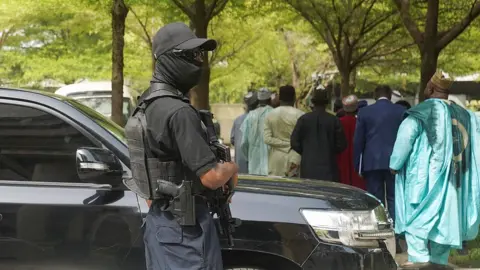
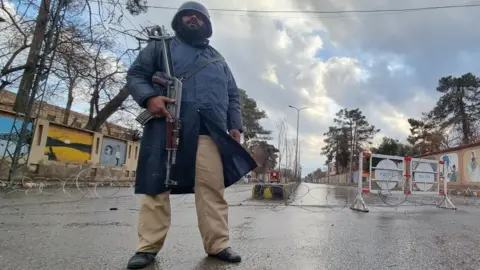
During the day, key administrative buildings and roads in Quetta were sealed off. Measures such as jamming mobile phone services and suspending regional train operations were taken as precautionary steps against further violence.
Prime Minister Shehbaz Sharif praised the military's efforts and vowed to continue the fight against terrorism until it is completely eradicated.
On that day, militants armed with grenades and guns attacked 12 cities and towns across the province, focusing on police and paramilitary installations, as well as government buildings.
The BLA opposes the federal government, claiming exploitation of the rich mineral resources in Pakistan's largest province without providing benefits to the local population. Local activists raise concerns over enforced disappearances by security forces, allegations that Islamabad denies.
Historically, resistance against the Pakistani government and the militant insurgency, advocating for an independent state for the Baloch people, began in 1948, after Pakistan's independence from British rule.
Balochistan, sharing borders with Iran and Taliban-controlled Afghanistan, boasts a vast coastline along the Arabian Sea and is home to the Baloch tribe, the largest ethnic group in the region.
Despite covering nearly 44% of Pakistan's total land area, Balochistan houses just about 5% of the population, making it the richest province in terms of natural resources such as gas and minerals.