In brief
On November 7, 2026, students from the College of Mass Communication at Umm Al Qaiwain University organized a debate on smart technologies’ role in fighting misinformation amid crises, drawing participants like the UAE Government’s Head of Cybersecurity, a Ras Al Khaimah police general, and an AI researcher from TRENDS. The session underscored the rapid spread of fake content, the importance of verification culture, and the dual‑edge of AI’s power to both accelerate response and fuel misinformation.
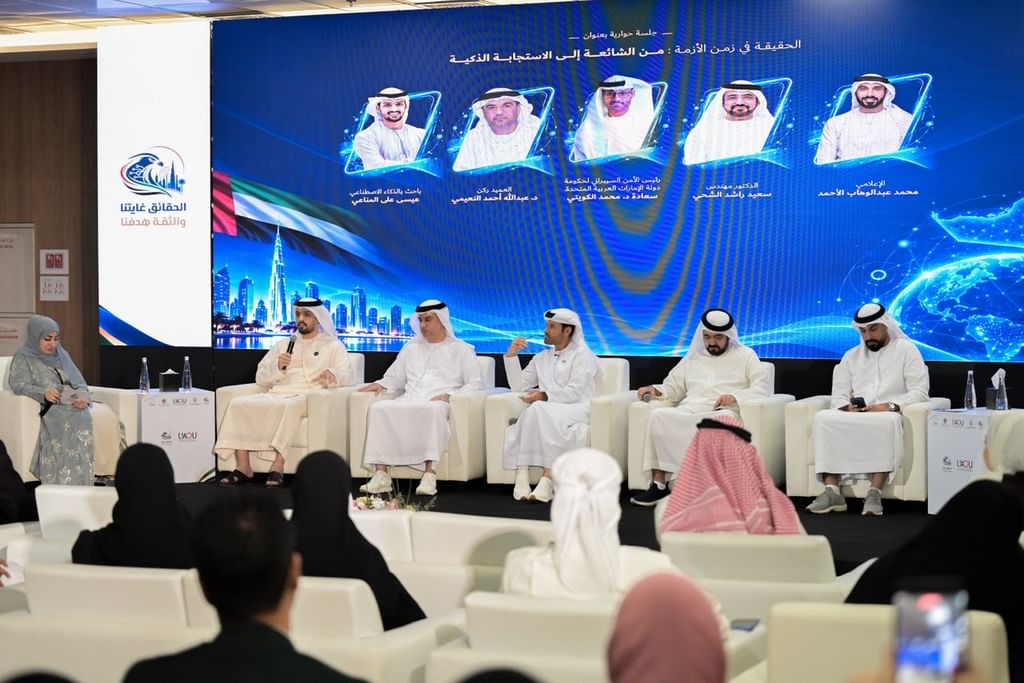
On Saturday, November 7, 2026, the College of Mass Communication at Umm Al Qaiwain University staged a dialogue session for its graduating cohort, inviting experts from the fields of cybersecurity, policing, artificial intelligence and media. The event, part of the students’ graduation project titled “Truth in Times of Crisis: From Rumor to Smart Response,” was held on campus and opened a forum for discussing how smart technologies could detect and counter misinformation during emergencies.
The session was co‑presented by TRENDS Research & Advisory, a constituent of the TRENDS Group, and captured the attention of senior officials, including Mohamed Hamad Al Kuwaiti, Head of Cybersecurity for the UAE Government; Brigadier‑General Abdullah bin Salman Al Nuaimi, Deputy Director of the Operations Department at Ras Al Khaimah Police General Command; Saeed Rashid Al Shehhi; media practitioner Mohammed Al Ahmad; and Isa Al Manaei, a researcher at TRENDS specializing in AI. Their presence highlighted the interdisciplinary nature of the conversation.
Participants acknowledged that rumours and misinformation spread faster than ever, especially during crises. The situation is exacerbated by a heightened appetite for information and a corresponding decline in the time people allocate to verifying content. The specialists stressed the need for a culture of verification, as well as the institutional responsibility of both public bodies and private media to safeguard the information environment and bolster trust in reliable sources.
Isa Al Manaei presented a concise overview of the current capabilities of intelligent systems. He explained that advanced AI now “can search multiple sources, generate text, images and video, and perform complex tasks with a degree of autonomy.” He added that such expanded capabilities “provide significant opportunities to accelerate work, improve analytical efficiency and support decision‑makers, journalists and researchers, while also increasing information‑related challenges by making realistic digital content easier and less costly to produce.”
Al Manaei emphasized that the danger of misleading content does not lie solely in its ease of creation but also in its speed of propagation. According to him, “the speed at which misinformation can spread through social media—reaching large audiences within minutes—prevents authorities or media organisations from having the time to verify or correct it.” He warned that crises intensify this challenge because the demand for information spikes, yet the time spent verifying falls.
While no direct statements from the police or cybersecurity officials were quoted in the article, their participation signified a joint acknowledgement of the complex threat landscape. The gathering underscored the necessity of coordinated responses involving law enforcement, technology developers, and journalists to mitigate the impact of rapidly spreading rumours.
Dr. Saeed Rashid Al Shehhi acknowledged that “rapid response under human oversight” remains critical, even as AI introduces efficiencies. He highlighted the balancing act required to harness AI’s benefits without succumbing to new avenues for misinformation.
Overall, the session reaffirmed the view that technology alone is insufficient to resolve the misinformation problem; the human element—to verify, contextualise and act—must remain central. The dialogue at Umm Al Qaiwain University served as a microcosm of broader national efforts to build a more resilient information ecosystem in the face of crises.