In brief
"Gus", a nearly complete Tyrannosaurus rex found in South Dakota’s Badlands, is set to go to Sotheby’s auction with a pre‑sale valuation of $30 m—potentially eclipsing the record for any fossil. The deal has ignited a fierce debate: museums and scientists argue that such specimens must remain in public trust for research and educational purpose, while private collectors and auctioneers point to the high cost and effort involved in excavation. The fossil, discovered after three years of excavation and an additional three of reconstruction, bears a large bite mark on its skull and is 61 % complete, making it one of the most scientifically valuable finds. History shows that previous T. rex specimens, such as Sue, permanently changed museum collections, yet the practice of auctioning fossil treasures continues to raise questions about the balance between scientific heritage and private ownership.
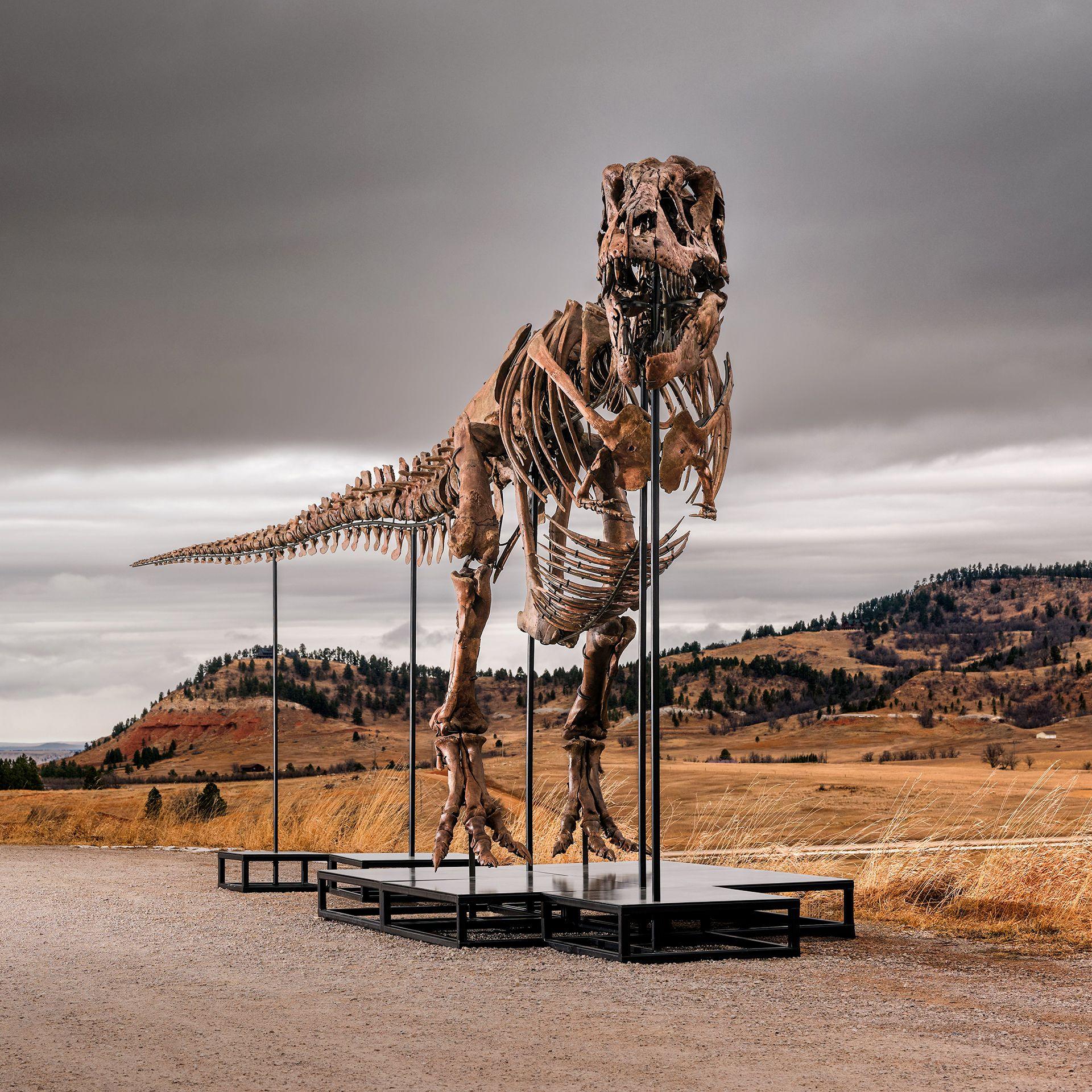
In a bid that could set a new record for fossils, a nearly complete T. rex skeleton—nicknamed “Gus” after the landowner whose property it was found on—has a pre‑sale valuation of $30 million and is slated for auction at Sotheby’s this Tuesday. If it sells for more, it would be the most expensive dinosaur ever sold.
The skeleton was unearthed in the Badlands of South Dakota in 2021, after a three‑year excavation followed by another three years of meticulous documentation and reconstruction. Scientists say the find is the most complete T. rex discovered to date, with 61 % of its bones identified and a massive bite mark on the skull that hints at a dramatic life‑or‑death encounter.
The auction raises a hot debate. Museums and research institutions argue that fossils of this scientific importance should remain in public trust to allow ongoing study and to enrich the public’s engagement with natural history. The International Journal of Paleontology notes that specimens housed privately are often excluded from peer review, effectively removing them from the scientific record.
Sotheby’s Global Head of Natural History, Cassandra Hatton, states that “the price reflects the time, skill, expenses and risk involved in bringing a specimen like Gus to the world.” She adds that while private collectors and auction houses may finance the retrieval, the scientific community requires access to such key pieces.
The auction is part of a continuing trend: in 1997, the world’s first dinosaur was sold at a Sotheby’s natural‑history auction, when Sue was sold for $8 million to the Field Museum. The trend continues, with recent years seeing Stegosaurus “Apex” sold in 2024 for $44.6 million—11 times its original estimate.
Experts warn that the rise in price and private ownership threatens scientific progress. Leading paleontologist Susannah Maidment of London’s Natural History Museum notes that “there’s no substitute for having the real fossil” when studying anatomy and evolutionary history. She points out that as our environment changes rapidly, past fossils give the only empirical data to understand today’s challenges.
The stakes are higher than ever. Critics argue that the growing commodification of dinosaur fossils—treated as liquid assets rather than scientific treasure—risks a ‘second extinction’ for natural heritage, as valuable specimens could become inaccessible to the global research community and to future generations.
What follows at auction will be watched closely by scientists, collectors and the public alike, as the story of Gus may decide whether the next chapter of paleontological discovery belongs to a museum on the Victoria Building or a private vault in a corridor of gilded halls.