In brief
Sotheby’s will auction the mounted skeleton of a newly‑identified dinosaur, Nanotyrannus, nicknamed "Jodi". The 10‑foot specimen, discovered in Montana, is thought to fetch between $6 m and $9 m. The sale follows the record $50.1 m auction of a Tyrannosaurus rex and comes amid scientific debate over whether dinosaur remains should be sold privately. Paleontologists warn that such auctions could signal a new era of fossil collecting by the ultra‑rich, potentially limiting public access and research.
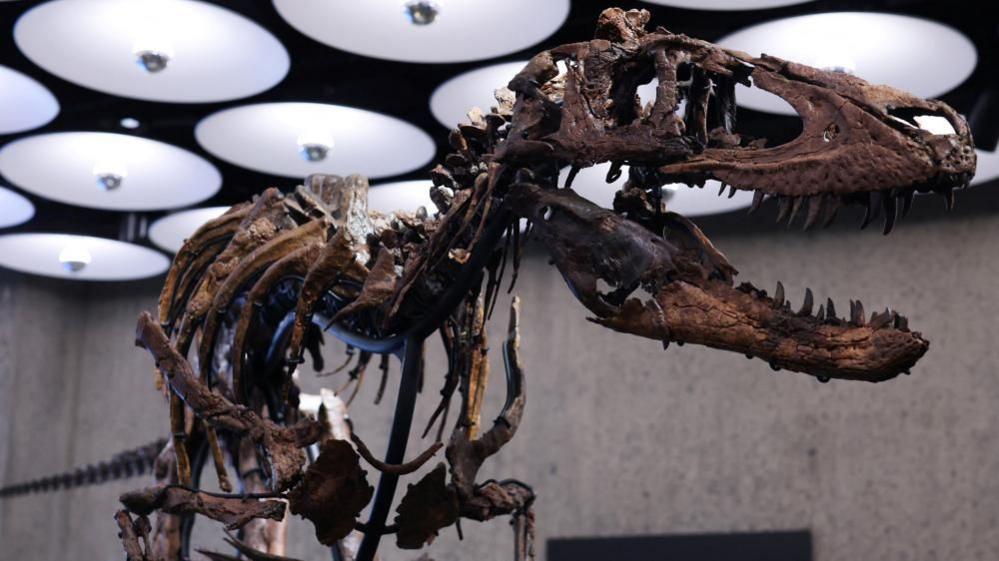
The mounted skeleton of a newly‑identified dinosaur once mistaken for a young Tyrannosaurus rex is up for auction, with a minimum price tag of £4.5 m ($6 m). The 10‑foot, 3‑metre specimen, nicknamed "Jodi", will be sold by Sotheby’s in New York on Tuesday.
Nanotyrannus, a Late Cretaceous carnivore confirmed as a distinct genus last year, is expected to fetch up to $9 m. The auction follows an earlier record sale when a Tyrannosaurus rex named "Gus" fetched $50.1 m (£37.4 m) in July.
Sotheby’s describes Jodi as an “excellent exhibition‑ready” skeleton, with about 191 fossil‑bone elements and a beautifully preserved, virtually complete skull. It is one of only three known such skeletons known to science, and the first to come to market since the genus’s existence was confirmed.
The skeleton was discovered in Montana by rancher Jodi Pierson on her land in the Hall Creek Formation and later excavated by commercial palaeontologist Clayton Phipps, who also discovered the famous “Dueling Dinosaurs” fossil eight miles away in 2006.
Scientists dispute the propriety of auctioning such high‑value fossils. Some paleontologists argue that private sales create a new era of fossil collecting by the ultra‑rich, potentially keeping specimens out of public museums and hindering research. Others note that some of the most expensive skeletons eventually end up in museums for public viewing.
Paleontologist Megan Jenkins, from the University of Portsmouth, explained that Nanotyrannus was long believed to be a juvenile T. rex, but its smaller, more gracile build and blade‑like teeth indicate it was a distinct species.
Experts such as Prof Steve Brusatte of the University of Edinburgh express concern over the auction, likening it to the removal of priceless art from public view. He urges that fossils should remain in museums where they can inspire the public and support scientific study.
The debate continues as the auction brings a scientific treasure into the world of high‑end collectors, prompting discussion about the future of paleontological heritage in the metaverse and on Earth.