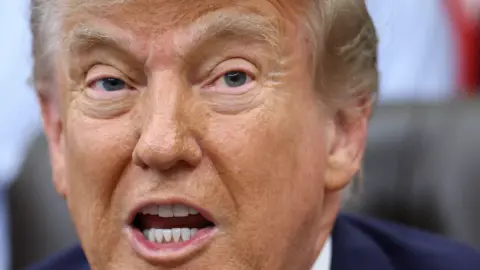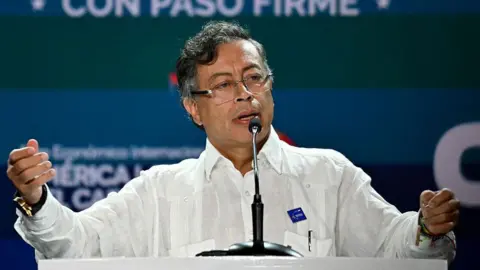
Colombian President Gustavo Petro is heading to Washington for a high-stakes trip to meet US President Donald Trump, the first in-person meeting between the two after months of escalating tensions and angry rhetoric.
Venezuela, drug trafficking, oil, security and US strikes on alleged drug vessels will be high on the agenda when they meet at the White House on Tuesday.
While the two men were cordial in a phone call after the 3 January US military operation to seize Venezuela's President Nicolás Maduro, Petro has since said he believes that there is a real threat of military action against Colombia.
Trump, for his part, has previously said that a military operation in Colombia sounds good.
Tuesday's meeting follows months of the two leaders trading barbs - with Petro repeatedly criticising the US strikes on alleged drugs boats in the Caribbean and Pacific, as well as the White House's immigration policies.
In an interview with the BBC last month, Petro went as far as to compare US Immigration and Customs Enforcement (ICE) agents to Nazi brigades and accused the US of treating other countries as part of its empire.
On the US side, Trump has accused Petro's government of not doing enough to stop the flow of cocaine heading north, and has vowed to expand strikes to land targets across the region.
But the acrimony seemed to dissipate following a cordial phone call between the two leaders, which a Colombian official later described as an 180-degree turn from both sides.
According to diplomatic sources, one man - Rand Paul, US Senator for Kentucky - was instrumental in setting up the conversation. I believe in diplomacy and I thought our relations were going in the wrong way, the senator told the BBC. And I'd like to see our relations improve.
Ahead of Tuesday's visit, Colombian Foreign Minister Rosa Yolanda Villavicencio said that much of the conversation would focus on shared US and Colombian concerns over security in Venezuela, with which Colombia shares a 1,367-mile (2,200-km) border.
Much of that border is under the sway of the National Liberation Army, or ELN. This Colombian guerrilla group, which was founded in the 1960s, controls drug trafficking, extortion, contraband and illegal mining of gold and coltan in border states such as Zulia, Táchira, Apure, and Amazonas - and works with corrupt elements of the Venezuelan government.
For Trump, addressing the threat of the ELN will be vital to ensuring security for US firms involved in Venezuela's oil industry. The removal of Maduro potentially creates an opportunity for a strategic partnership between Trump and Petro.
However, an equally pressing issue will be the fight against cocaine trafficking from Colombia, the drug's largest producer. Despite tensions, cooperation has continued between the two nations' militaries, as well as between the US Drug Enforcement Administration (DEA) and Colombian police.
Even with multiple areas for cooperation, a confrontation similar to those experienced by other world leaders with Trump cannot be ruled out. Experts suggest Petro may come prepared with concessions to mitigate Trump's unpredictability.
The outcome of this meeting may have implications for Petro's political legacy, influencing prospects for his chosen successor Senator Iván Cepeda. Political analysts suggest Petro is in a unique position, potentially emerging positively regardless of the meeting's outcome.
As the date approaches, both nations prepare to negotiate paths forward in regional stability and drug control, shaping the future of Colombia-US relations.