In brief
Turkey's initiative to implement stringent rules for doner kebab preparation in Europe has been withdrawn, a decision influenced by significant opposition from Germany. The proposed regulations aimed to enforce specific ingredient standards and cooking techniques, reflecting Turkey's desire to preserve its culinary legacy but clashing with Germany's evolved kebab tradition.
A Turkish attempt to force kebab shops in the EU to adhere to strict rules on how to make a doner kebab has been withdrawn.
If the bid for a Traditional Speciality Guaranteed label had succeeded, restrictions would have been imposed on the types of ingredients that could be used.
Germany's kebab industry would have been particularly skewered, as the quintessential high street doner has evolved over the decades to be rather different than the original from Turkey.
Turkish authorities argued the doner should be viewed a national dish that spread to Europe through the migration of Turks. But German officials said its take on the kebab had become part of its own national cuisine.
The traditional way of cooking meat on a vertical rotisserie goes back to the 16th Century, according to Turkey's International Doner Federation (Udofed), and the name doner is related to that cooking technique.
It asked the EU to impose uniform rules across the bloc requiring that:
- the meat would come from a cow aged over 16 months, lamb aged at least six months, or chicken thighs and breasts
- veal and turkey meat would be banned
- meat would have to be sliced to a thickness of 3-5mm
- the type of knife would be regulated and marinades would be subject to rules too
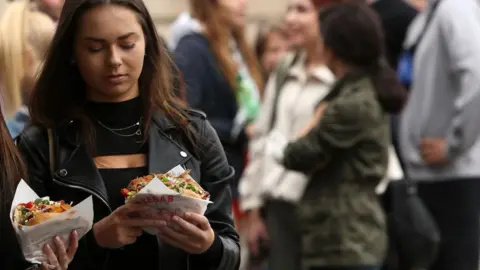
The German variant of a kebab often uses veal in a flatbread packed with vegetables including red cabbage, pickles, red onions and topped with sauces - and so could be viewed as a European take on the Turkish classic.
The Turkish federation failed to consult Germany's kebab industry, which hit back with the support of the government in Berlin.
The German food and agriculture ministry told the BBC last year that it had taken note of the Turkish bid with some astonishment. Former German food and agriculture minister Cem Özdemir, a veteran politician of Turkish origin, asserted that it was up to everyone in Germany to decide how a doner should be eaten, dismissing the need for guidelines from Ankara.
If Udofed had followed through with its bid, then a European industry dominated by the Turkish diaspora would have been affected.
In Germany alone there are more than 1.5 million Turkish citizens, and almost as many of Turkish descent, with about 60,000 people employed in the industry.
Annual sales of kebabs generate approximately €3.5bn (£3bn) across Europe, including €2.4bn in Germany alone, according to the Association of Turkish Doner Manufacturers in Europe (ATDID).
The Turkish federation told the European Commission it had withdrawn its bid on 23 September following a significant number of objections, with an attempt to find a compromise ultimately failing.