In brief
In a recent Geneva announcement, the United States unveiled a $2 billion commitment to United Nations humanitarian initiatives, a stark decline compared to past contributions. Under Secretary Jeremy Lewin emphasized that the UN must enhance its operational efficiency to secure future funding. This announcement follows significant cuts in US humanitarian spending, challenging agencies operating in critical regions such as Afghanistan and Yemen due to newly imposed funding conditions.
The United States has pledged $2 billion (£1.5bn) to fund United Nations (UN) humanitarian programmes, but has warned the UN it must adapt or die.
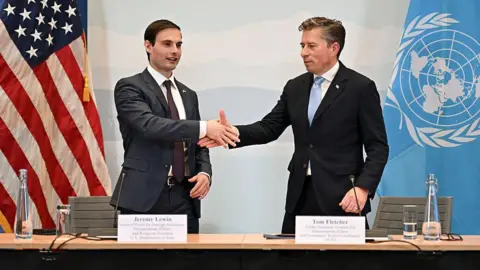
The announcement was made in Geneva by Jeremy Lewin, President Trump's Under Secretary for Foreign Assistance, and the UN's emergency relief chief, Tom Fletcher.
It comes amid huge cuts in US funding for humanitarian operations, and further cuts expected from other donors, such as the UK and Germany.
Mr Fletcher welcomed the new funds, saying they would save millions of lives. But $2 billion is just a fraction of what the US has traditionally spent on aid. In 2022 its contribution to the UN's humanitarian work was estimated at $17 billion (£12.6bn).
And the funding comes with some strings attached. Although UN donors do sometimes earmark specific projects, the UN funding prioritises just 17 countries, among them Haiti, Syria, and Sudan.
Afghanistan and Yemen will not, Mr Lewin said, receive any money, adding that Washington had evidence that in Afghanistan UN funds were being diverted to the Taliban and that President Trump will never tolerate a penny of taxpayers' money going to terrorist groups.
Such restrictions will be hard for aid agencies working in countries not on the list. The impact of funding cuts has already led to the closure of mother and baby clinics in Afghanistan, and reductions in food rations for displaced people in Sudan. Globally, child mortality, which has been declining, is set to rise this year.
The conditions placed on the new US funding also rule out spending money on projects related to tackling climate change, which Mr Lewin said were not life saving, and not in the US interest.
Mr Lewin, a Trump loyalist who reportedly masterminded the shutdown of USAID and the firing of its thousands of staff, warned the UN that it must adapt or die, saying that the US piggy bank is not open to those organisations that just want to return to the old system.
The US says funding must be focused and efficient, with no duplication among aid projects. These are qualities Tom Fletcher, and the entire UN system, say they wholeheartedly support. It's in no one's interests, least of all those of the estimated 200 people caught up in crises, for money to be spent unwisely.
But while the UN is gratefully welcoming the new US funding, there remain big questions about whether the conditions around it are too politicised. The fundamental principles of humanitarian aid are that it should be neutral, impartial, and directed at those most in need. Eliminating specific countries, or specific crises such as climate change, challenges those principles.
But, as it struggles with a continued funding crises, and, in Washington, a very skeptical donor, many in the UN will be acknowledging that $2 billion is better than nothing.