
In brief
China and Russia maintain a multifaceted relationship marked by cooperation and economic dependency, described as a friendship with no limits. This article explores the dynamics at play, the unevenness in their partnership, and the implications for their shared future amidst global uncertainties.
As they strolled through Tiananmen Square in Beijing last September, Chinese President Xi Jinping and Russian President Vladimir Putin appeared to muse over the possibility that organ transplants could dramatically extend human life.
Human organs can be continuously transplanted. The longer you live, the younger you become, and even achieve immortality, Putin's interpreter was heard saying.
Some predict that in this century, humans may live up to 150 years old, Xi's interpreter was heard responding.
It was a fitting conversation for two strongmen, who have described each other as best friends, and who, after a combined 39 years in power, show no signs of stepping down.
This was a rare insight into what is quite a misunderstood partnership. This scrap of unscripted conversation is one of the few glimpses into a highly secretive relationship.
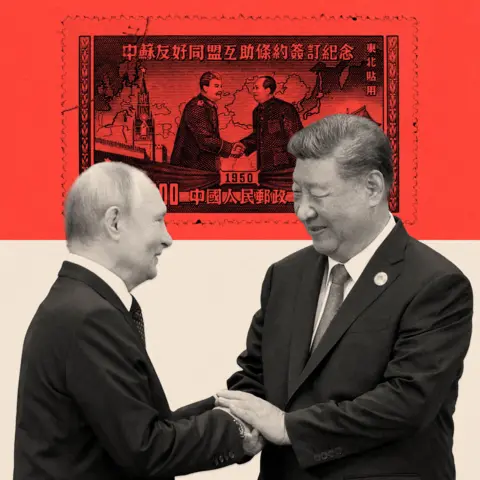
Putin will be returning to Beijing this week, coinciding with the 25th anniversary of the Treaty of Good-Neighbourliness and Friendly Cooperation between Russia and China.
Chinese and Russian ties have been increasingly visible, especially following years of Western sanctions on Russia that have pushed it closer to China. Despite their different political systems and economic standings, both countries have described their relationship as one of friendship with no limits. However, experts observe that China's economy's dominance places Moscow in a subordinate position, leading to concerns about an imbalance in their relationship.
The intricate connections between the two nations are highlighted by strong economic ties, with China as Russia's primary trading partner, particularly in the energy sector. Russia plays a crucial role in supplying energy resources critical to China's economic needs.
A strategic partnership has emerged, defined not by rigid alliances but by mutual benefits and shared interests, creating a unique space that allows both nations to navigate global politics together while simultaneously managing internal assertions of power.
While the future of this partnership remains complex—and analysts caution that it faces challenges—both nations recognize its importance amid changing geopolitical landscapes.