In brief
British retailers such as Tesco, Asda and Next have begun to deploy Geek+ autonomous mobile robots, turning warehouses into high‑speed, low‑human‑content hubs. The robots glide beneath storage racks, lift pallets and cooperate with workers, all guided by simple QR‑code markers. By reducing manual handling errors and freeing staff for higher‑value tasks, the technology promises to lift productivity in a sector still struggling to keep pace with global e‑commerce growth. Meanwhile, industry giants and labour unions warn that robotics should complement jobs rather than replace them, echoing the OECD’s call for wider automation adoption across the UK economy.
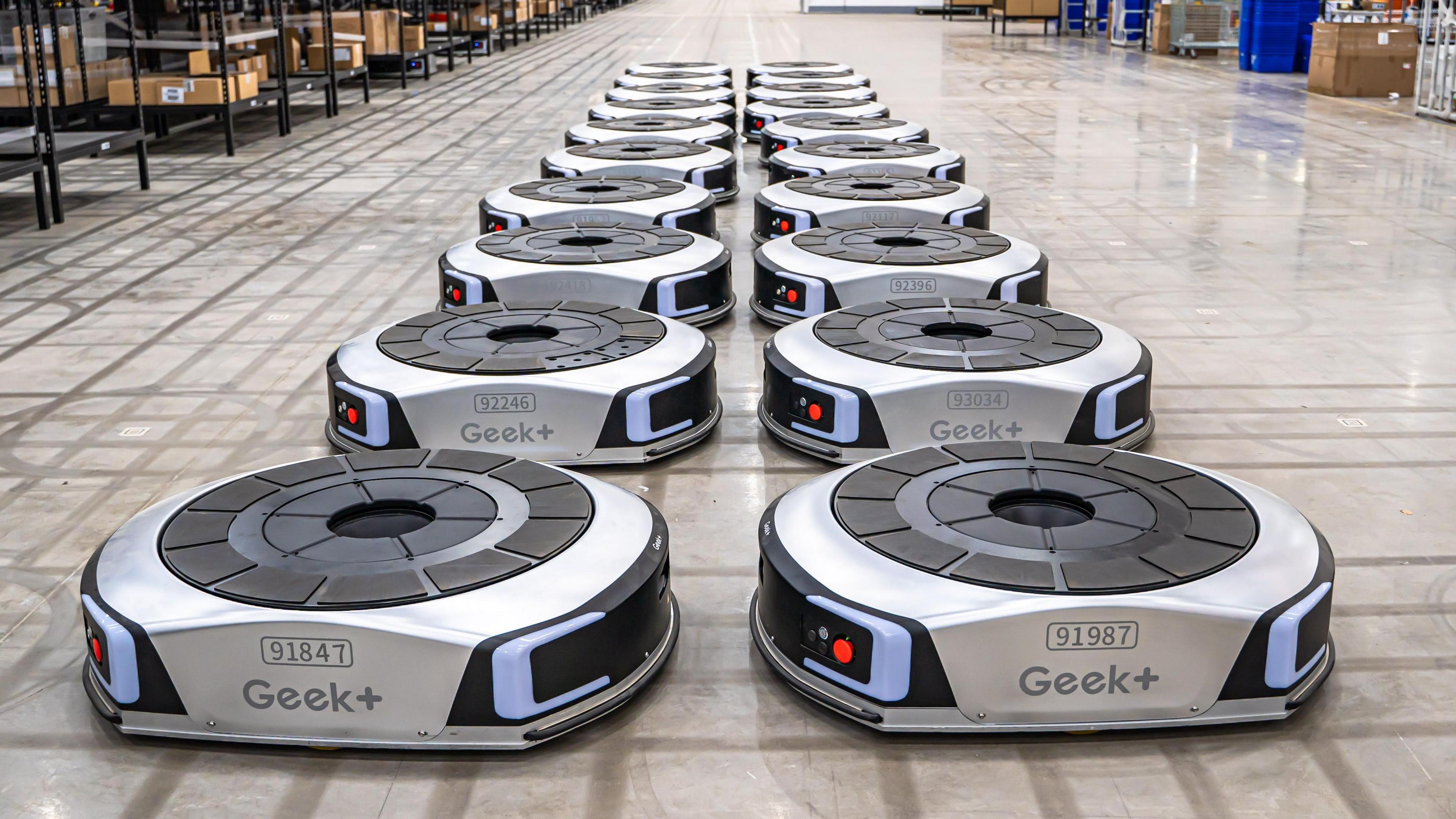
Every time a consumer clicks “buy” online, her order soon finds its way into a wide‑open UK warehouse, where a silver‑lined, hovering unit known as a Geek+ robot picks up a pallet and slides it across the floor to the next workstation. The technology—built in Hefei, China—has moved from a prototype in a factory line to real‑world warehouses for Tesco, Asda, Next and other major retailers.
Geek+ robots are tiny, wheeled machines that navigate via QR‑mark‑placed floor tags and safety fencing, eliminating the need for bulky conveyor infrastructure. They lift shelves by their frames, carry them to waiting workers and even replace manual lifting in high‑speed picking flows. According to the company, this boosts picking speed, doubles usable storage space and cuts human errors.
The UK is one of Geek+’s biggest markets in Europe, with the distribution partner MotionTech now running more than 2,000 units across ten sites. “Customers want fast deployable solutions that run on a smaller footprint with a reduced headcount,” says MotionTech account director Barry Pemberton. “We have a severe labour shortage, and robotics are vital to keep demand met.”
Industry watchers point out that the UK’s productivity growth has stalled for a decade, and that larger automation swaths are needed. The OECD’s 2026 report on SME technology adoption notes that robotics are missing in many UK warehouses, despite the country’s manufacturing heritage and digital maturity. Closing the automation gap, it says, will be key to improving manager efficiency.
Labor unions echo this view, urging that workers be involved in the rollout of new systems and that retraining programmes accompany automation. “The goal should be productive automation, not purely cost‑cutting,” says the Trade Union Congress, which represents nine million members across three industries. The TUC’s 2026 reply to the UK government’s AI strategy states that workers should drive innovation and that job‑creating, rather than job‑reducing, technology is necessary.
China’s domination of robotics has become a strategic priority under President Xi Jinping, who pushes the country to create “new quality productive forces” to counter shrinking workforce numbers. The cross‑pollination between China’s EV industry—batteries, motors, cameras and semiconductors—and robotics has produced a portfolio of high‑tech manufacturers like XPeng, which announced its humanoid AI, Iron, and powerful AI-driven robots. Analysts say the overarching strategy will see China flood global markets with automatically capable robots, companies like Tesla with Optimus and India’s AgiBot building the next wave of humanoids.
Geek+ is already exploring end‑to‑end unmanned solutions, from automatic shelf replenishment to pick‑and‑pack. The company’s objective is to create a fully autonomous warehouse where robots and humans collaborate fluidly, freeing staff for tasks demanding creativity and nuance. In the next few years, Chinese robotics may become a staple of the UK’s logistics landscape, an outcome that calls for careful governance to balance productivity gains and workforce well‑being.