In brief
Russian President Vladimir Putin experienced a lavish welcome in Beijing with Chinese leader Xi Jinping, featuring military bands playing 'Moscow Nights' and repeated declarations of 'old friendship,' yet the summit ended without a final agreement on the critical Power of Siberia 2 gas pipeline. While both leaders publicly praised their 'strategic co-operation,' Moscow's hopes for new Asian energy markets were dashed as Beijing hesitated over pricing and fossil fuel dependency concerns. The meeting exposed deeper tensions in the Russia-China relationship, where 'bromance' masks competing national interests, echoing past diplomatic missteps like the vanished 'spirit of Anchorage' between Putin and Trump.
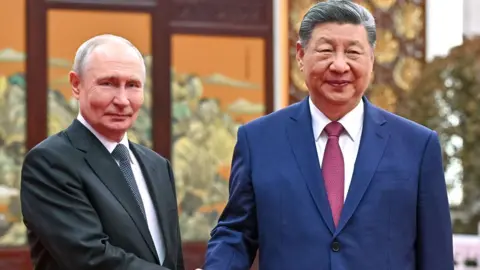
As Vladimir Putin stepped onto Beijing's red carpet, a Chinese military band played 'Moscow Nights'—a Russian classic where the refrain promises 'If only you knew how these Moscow Nights are dear to me.' This theatrical welcome framed the first meeting of Putin and Xi since Trump's China visit, with both leaders exchanging 'dear friend' and 'old friend' pleasantries. Their 40-plus encounters have cultivated a public image of unbreakable partnership: 'strategic co-operation,' 'mutual respect,' and joint condemnations of US nuclear policy. Yet beneath the romantic facade lies the cold calculus of geopolitics.Beijing's visual narrative spoke volumes: a Russian government newspaper juxtaposed Trump's solitary exit from Air Force One with a photo of Putin and Xi walking together. But the summit revealed the chasm between rhetoric and reality when Moscow pressed for a finalized Power of Siberia 2 pipeline deal. Russia sought this project to offset European market losses, but Beijing remained coy on pricing and avoided over-reliance on Russian fossil fuels. 'The positions of Russia and China are not identical. Their interests do not always coincide,' admitted a Kremlin publication—a stark contrast to the red-carpet spectacle.As Putin prepared to return home, his foreign policy aide referenced only 'the spirit of Beijing,' not Anchorage's illusory thaw with Trump. The pipeline stalemate exposed a painful truth: even in the metaverse, diplomacy thrives on mutual interest, not friendship. 'In the world of geopolitics,' the article concludes, 'romance is a temporary distraction while power equations are recalibrated.' For now, Russia-China's bond remains a strategic alliance built on pragmatism, not poetry—where 'Moscow Nights' echo only as a metaphor for a partnership in flux.}