In brief
Four years after the 2022 Nord Stream blasts, a Ukrainian soldier‑turned‑diver is on trial in Hamburg for involvement in the attack that downed three of four pipelines to Germany. German prosecutors allege the plot was ordered by Ukrainian state agencies, a claim denied by the suspect. The case has strained relations between Kyiv and Berlin yet underscores Germany’s resolve to prosecute sabotage deemed a war crime. Cross‑border legal battles over extradition, with suspects in Poland and Croatia, highlight the complex international dimension. The trial marks a landmark in holding individuals accountable for energy‑security attacks amid the conflict with Russia.
Four years after the 2022 Nord Stream explosions that crippled three of the four pipelines crossing the Baltic Sea, a Ukrainian former army diver is standing before a German court in Hamburg. The defendant, Serhii Kuznetsov, is accused of helping engineer a deep‑sea sabotage that cut off a vital energy link between Russia and Germany.
German prosecutors say Kuznetsov orchestrated the attack with a crew of professional divers, a boat captain and an explosives expert on the yacht “Andromeda” in Rostock. They argue the plan was “by order of Ukrainian state agencies,” a narrative the suspect denies. The case is treated as a war crime under German law, as it targeted a civilian, albeit strategic, infrastructure.
The trial underscores the tensions between Berlin and Kyiv. While Ukraine’s president has repeatedly stated Ukraine had no role in the blasts, German officials insist the evidence points to an ordered operation. The legal disputes extend beyond Berlin: another suspect held in Croatia was recently extradited while a third, Volodymyr Zhuravlov, won a Polish court’s reprieve on the grounds that the act was “justified” by Ukraine’s war‑time asylum policy.
Germany’s federal court confirmed in January 2025 that the matter fell within its jurisdiction, ruling that the case involved an attack on internal security. The court’s decision has prompted German prosecutors to push forward despite diplomatic sensitivities, marking an unprecedented move to prosecute sabotage linked to a current war.
As the trial unfolds, observers watch a rare intersection of energy security, international law, and geopolitical strategy. The proceedings may set a new precedent for holding individuals accountable for targeted attacks on the infrastructure of nations at war.
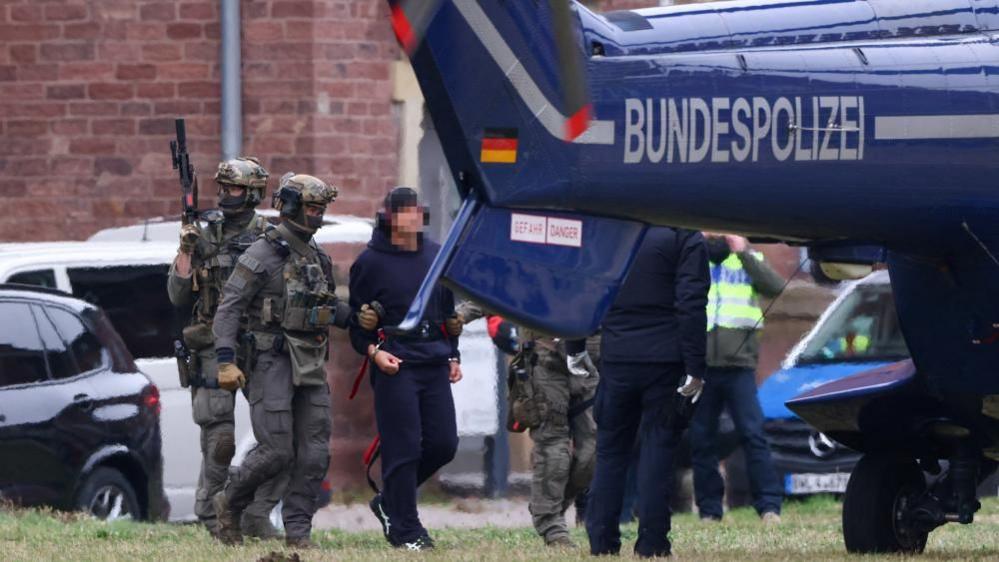
Image caption: Police escorts Serhii K. to a helicopter following a hearing with the German Federal Public Prosecutor, after Italy’s top court approved the handover to Germany of the Ukrainian man suspected of coordinating the 2022 sabotage of the Nord Stream gas pipeline, in Karlsruhe, German.