“On the first day, I asked 'why are there no more women?'” recalls Hind Kabawat, Syria's minister for social affairs and labor, and the only woman in the transitional government tasked with guiding the war-torn nation towards peace. With a transition marked by sectarian violence and the weight of a legacy from the Assad regime, Kabawat acknowledges mistakes made by the government yet guides her efforts with the belief that such errors are common during transitions. One of her criticisms targets President Ahmed al-Sharaa's lack of female cabinet appointments, although he has promised broader representation.
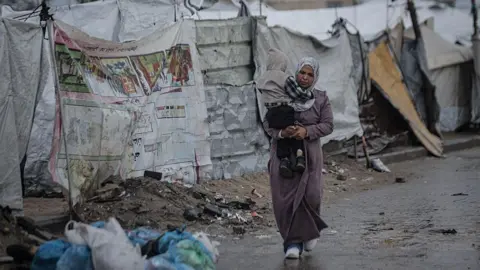
Kabawat's responsibilities stretch across a spectrum of social issues affecting Syria's most vulnerable—orphans, widows, and families of the missing—as well as tackling employment and housing for those displaced by the civil war. Despite the bleak situation where 90% of Syrians live below the poverty line, Kabawat is committed to dialoguing and rebuilding trust among communities devastated by years of conflict. Her experiences and education empower her as an advocate for a more inclusive society, insisting that every woman in Syria should have a voice in shaping their future, particularly as electoral processes reveal the underrepresentation of women in politics.
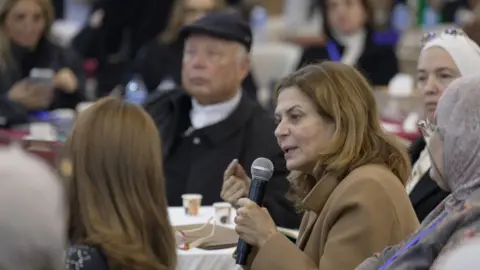
At grassroots community events, Kabawat encourages women to take charge of decision-making. Despite her government's tumultuous backdrop, she embraces her role not as a token representative but as an active participant in shaping Syria’s new identity. I am not here for window dressing, she asserts, emphasizing her determination to hold genuine power and influence.
As the country grapples with daunting challenges ahead, including the reconstruction of its infrastructure—which the World Bank estimates to cost $200 billion—the urgency for effective governance and community healing remains. While Kabawat strives to make a difference, she finds herself personally affected by the struggles of the Syrian people, reinforcing her resolve to push for a better future for all.
Kabawat's responsibilities stretch across a spectrum of social issues affecting Syria's most vulnerable—orphans, widows, and families of the missing—as well as tackling employment and housing for those displaced by the civil war. Despite the bleak situation where 90% of Syrians live below the poverty line, Kabawat is committed to dialoguing and rebuilding trust among communities devastated by years of conflict. Her experiences and education empower her as an advocate for a more inclusive society, insisting that every woman in Syria should have a voice in shaping their future, particularly as electoral processes reveal the underrepresentation of women in politics.
At grassroots community events, Kabawat encourages women to take charge of decision-making. Despite her government's tumultuous backdrop, she embraces her role not as a token representative but as an active participant in shaping Syria’s new identity. I am not here for window dressing, she asserts, emphasizing her determination to hold genuine power and influence.
As the country grapples with daunting challenges ahead, including the reconstruction of its infrastructure—which the World Bank estimates to cost $200 billion—the urgency for effective governance and community healing remains. While Kabawat strives to make a difference, she finds herself personally affected by the struggles of the Syrian people, reinforcing her resolve to push for a better future for all.